Imports: how to add subscribers to your account
Adding new contacts to Mailrelay is easy. This article walks you step by step through every way to import subscribers from the Subscribers > Imports menu.
- The imports list
- Creating a new import
- How to format your contacts
- Copy & Paste
- Import files (.csv or .txt)
- Import from Mailchimp or HubSpot
- How to view the subscribers in a group
The imports list
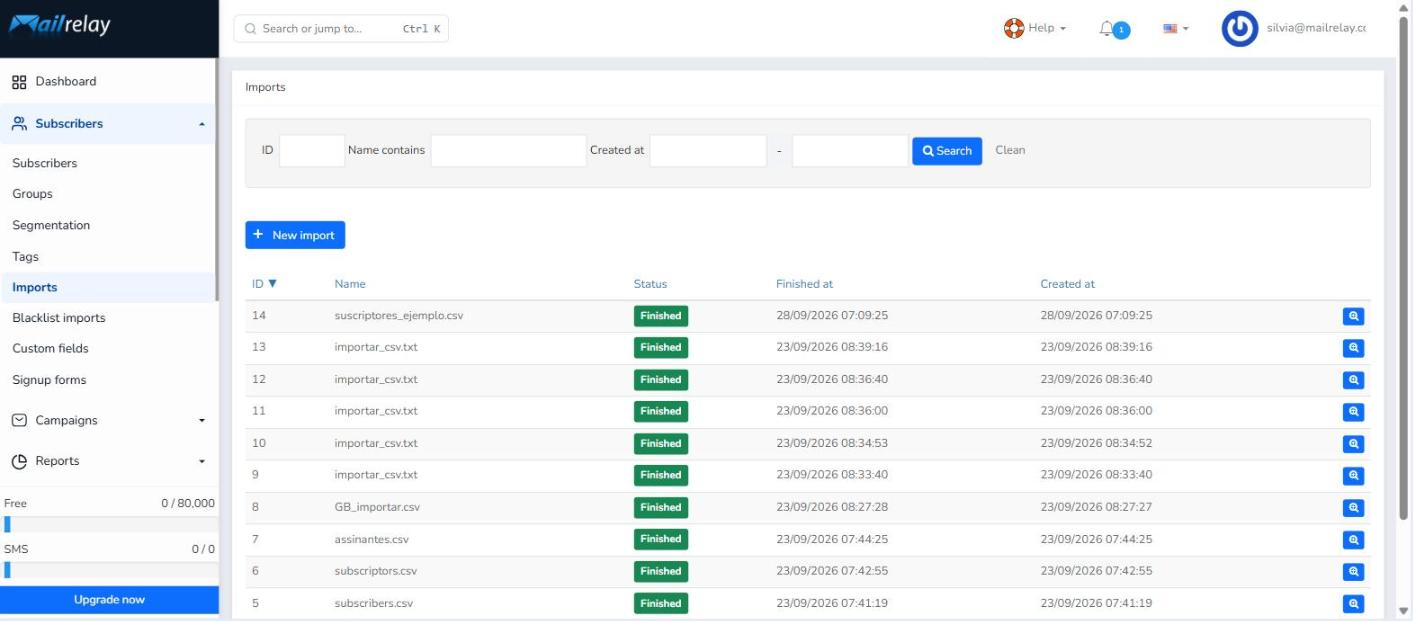
To get started, go to Subscribers > Imports. You will see a history of every import you have run.
- At the top there is a search bar with the filters ID, Name contains and Created at (a date range). Click Search to filter or Clean to clear the filters.
- The results table shows the columns ID, Name (the file name), Status (for example, Finished), Finished at and Created at.
- The magnifying-glass button at the right of each row opens the details of that import.
To import contacts, click + New import.
Creating a new import
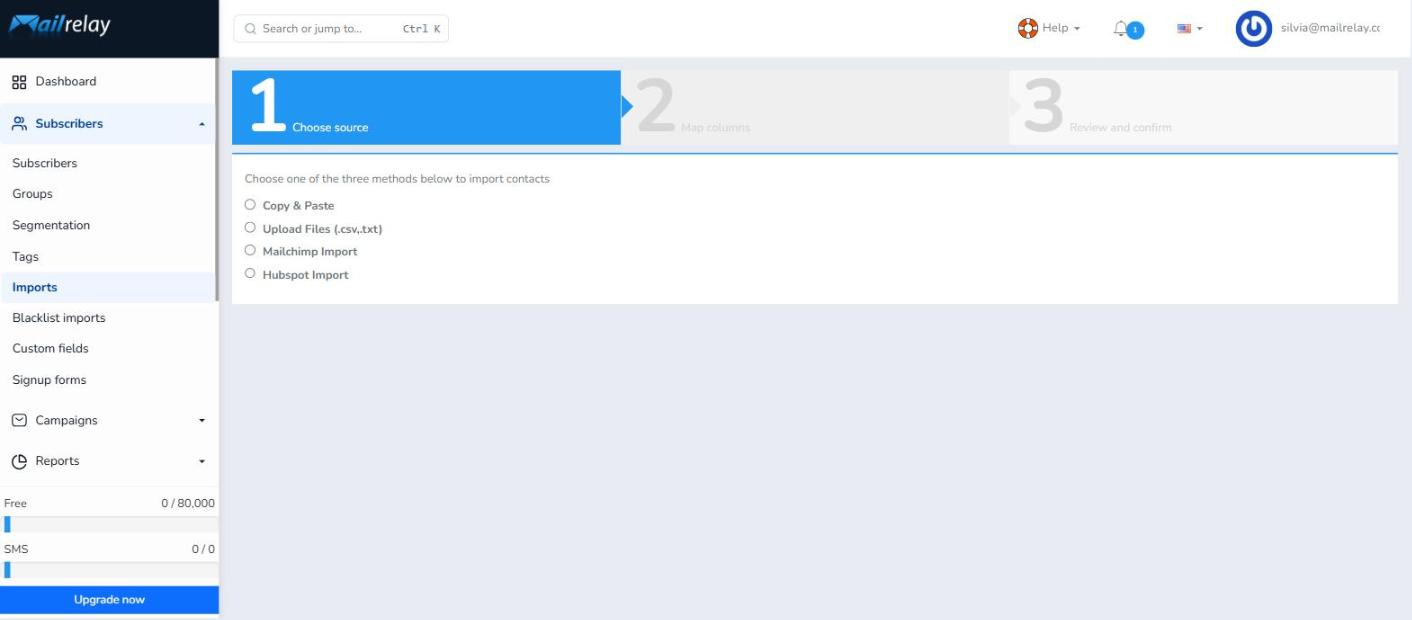
Imports are done in a three-step wizard: 1 Choose source, 2 Map columns and 3 Review and confirm.
In the first step, choose one of the four available methods:
- Copy & Paste: paste your contact list straight into the panel.
- Upload Files (.csv,.txt): select a .csv or .txt file containing your subscriber list.
- Mailchimp Import: move your contacts directly from your Mailchimp account.
- Hubspot Import: import your contacts from your HubSpot account.
How to format your contacts
For both Copy & Paste and Upload Files, the list must have one contact per line. If you are only importing email addresses, one address per line is enough:
subscriber1@domain.com
subscriber2@domain.com
subscriber3@domain.net
If you want to import more data for each contact (name, city, etc.), add it on the same line as the email, separated by commas:
John,john@domain.com,London
Emma,emma@domain.com,Dublin
Mark,mark@domain.com,Manchester
You can import as many fields as you need, but remember that each subscriber must be on a single line and every line must follow the same field order. With a .csv or .txt file you do not need to open it: the system reads it automatically when you upload it.
1. Copy & Paste
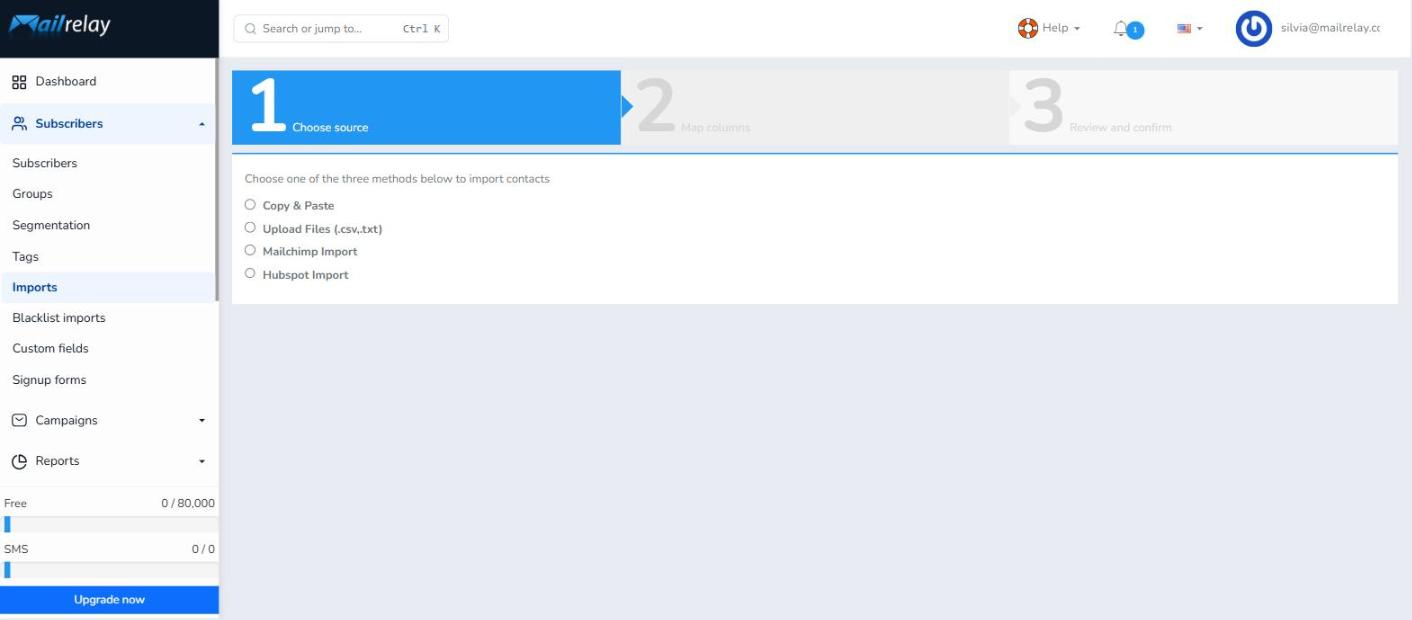
Select Copy & Paste. A text box opens where you paste your contacts. Then click IMPORT FROM TEXT.
The system takes you to step 2 Map columns, where it detects the columns in your list and shows you a preview of the data.
From here on, the process is the same as for file imports: see Map the columns and the following sections.
2. Import files (.csv or .txt)
Step 1: select the file
Select Upload Files (.csv,.txt) and drag your file onto the area Drop file here or click to select one, or click it to browse your computer. As soon as the file is uploaded, the wizard moves on to step 2 automatically.
Step 2: map the columns
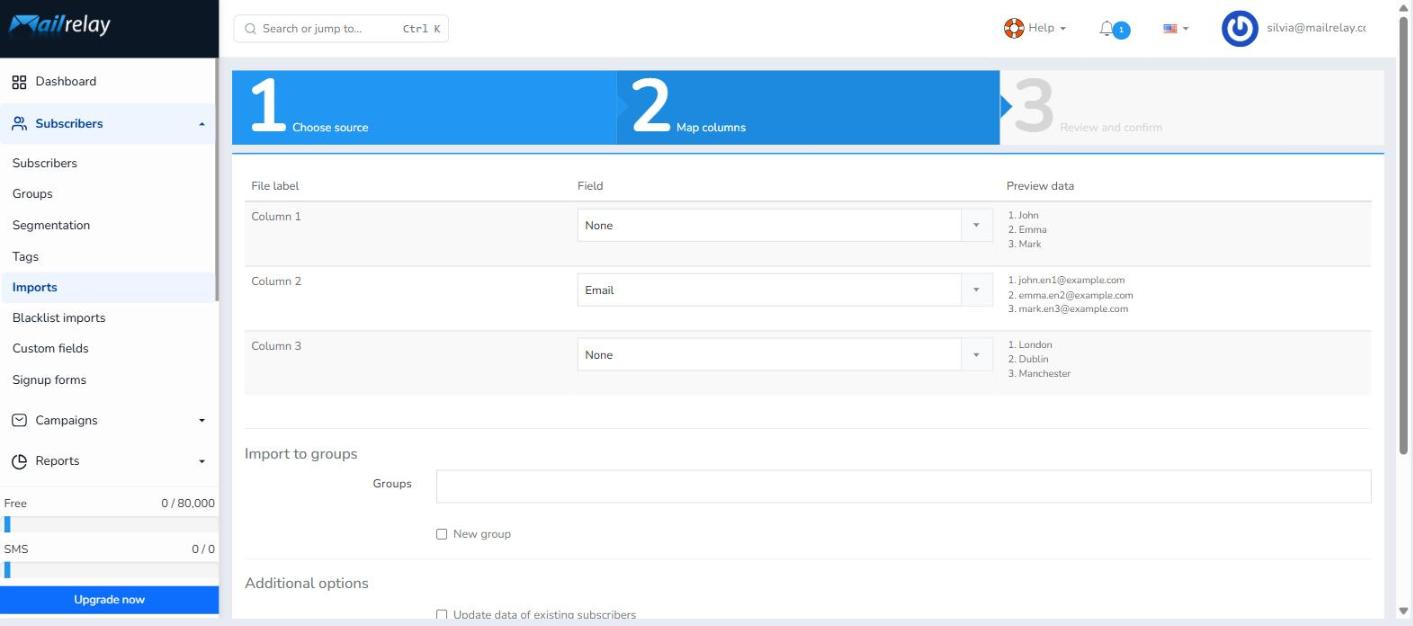
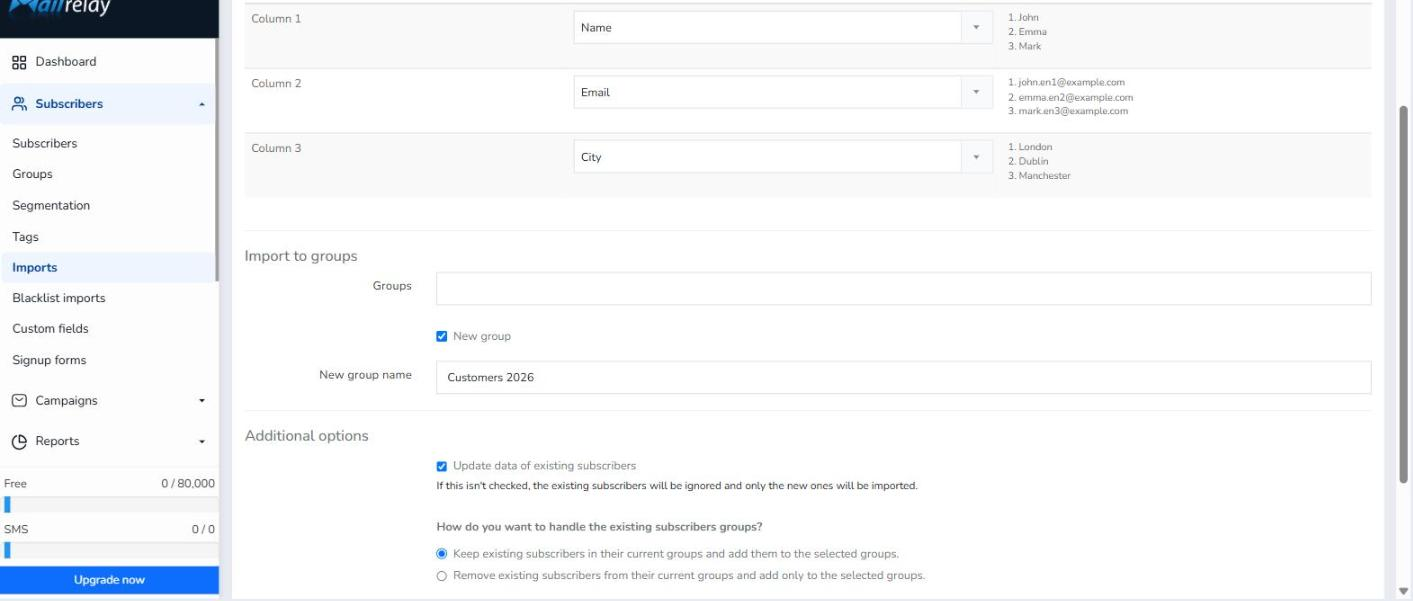
The system analyses the file and shows one row for each column it detects, with three pieces of information: File label (Column 1, Column 2…), Field (the Mailrelay field it will be linked to) and Preview data (the first values in that column). The column containing the addresses is linked to the Email field automatically, the others are set to None (they are not imported).
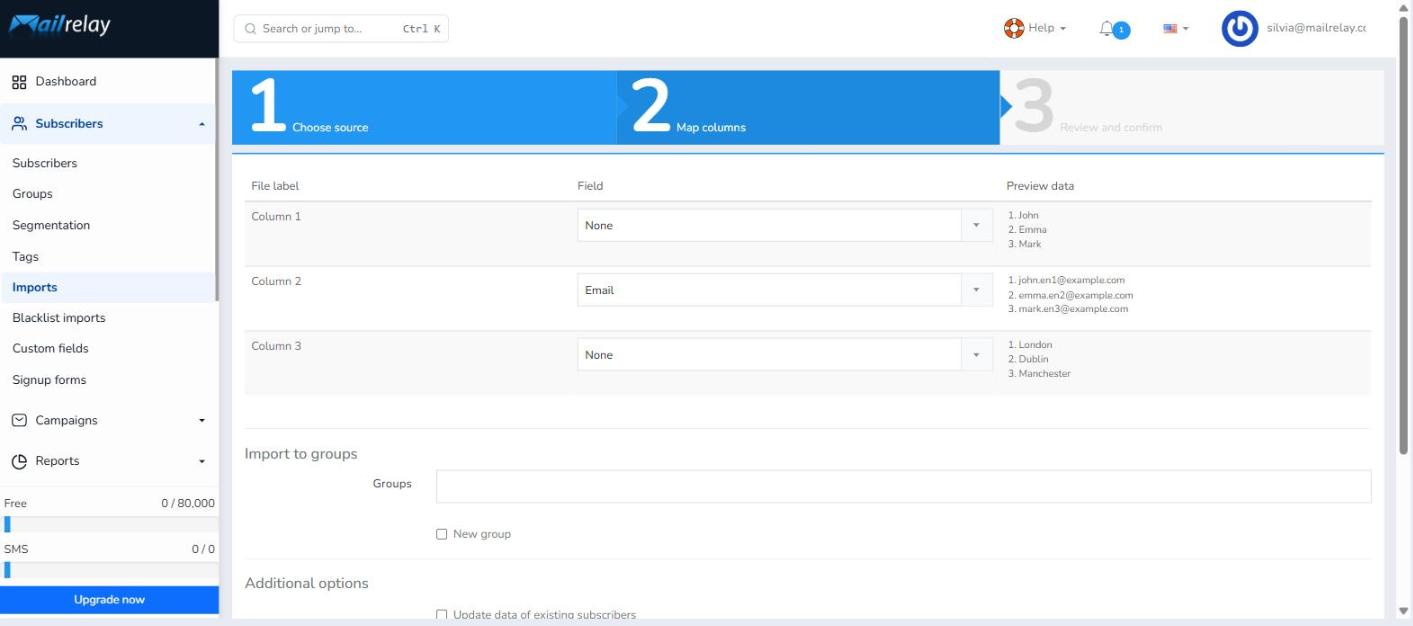
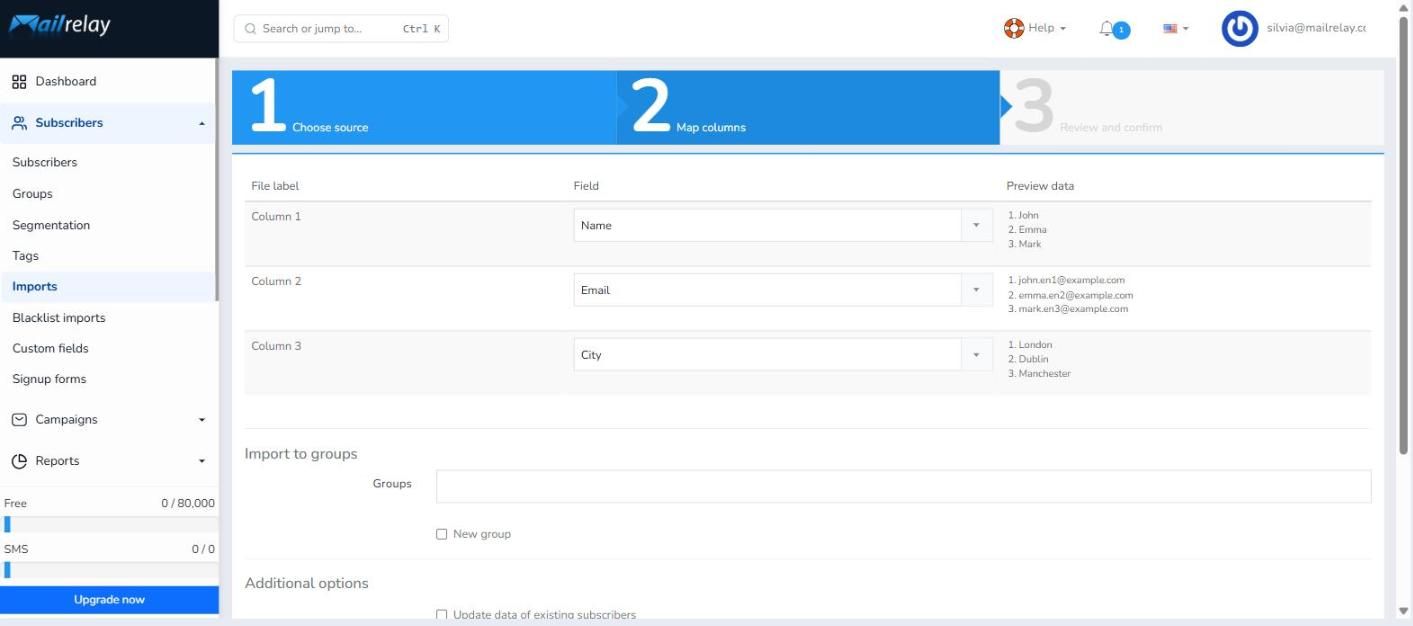
Use the drop-downs in the Field column to say what each column contains. You can choose, among others, the name, SMS or WhatsApp phone, address, city, state, country, birthday, website, language or any of your custom fields. Leave None on any column you do not want to import.
Step 3: choose the groups
In the Import to groups area, click the Groups field to see the groups in your account and select one or more.
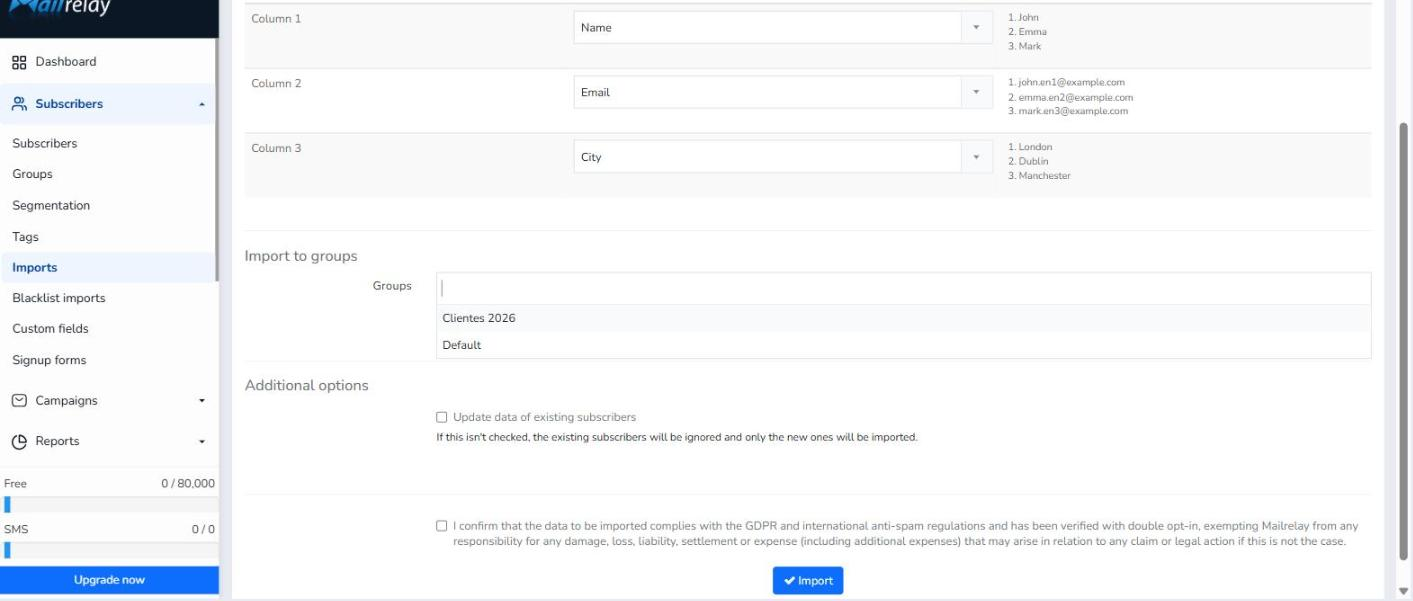
If you would rather create a new group for this list, tick New group and type its name in New group name.
Additional options: subscribers that already exist
Under Additional options you decide what to do with contacts that already exist in your account:
- If you do not tick Update data of existing subscribers, existing subscribers are ignored and only the new ones are imported.
- If you tick it, their data is updated with the data in the file and the question How do you want to handle the existing subscribers groups?appears, with two options:
- Keep existing subscribers in their current groups and add them to the selected groups. Contacts stay in their groups and are also added to the new ones.
- Remove existing subscribers from their current groups and add only to the selected groups. Contacts are removed from the groups they were in and remain only in the groups of this import.
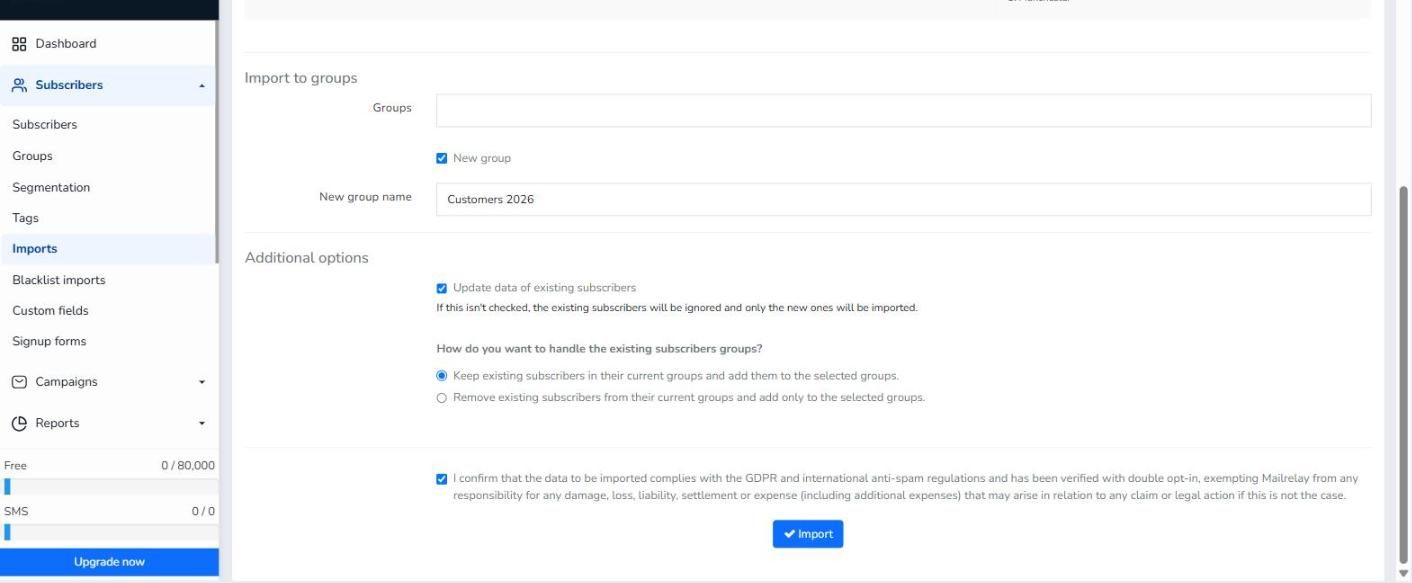
Confirm GDPR compliance and import
Tick the box I confirm that the data to be imported complies with the GDPR and international anti-spam regulations and has been verified with double opt-in…, which exempts Mailrelay from any liability if this is not the case. Once you have reviewed everything, click Import.
Review the import result
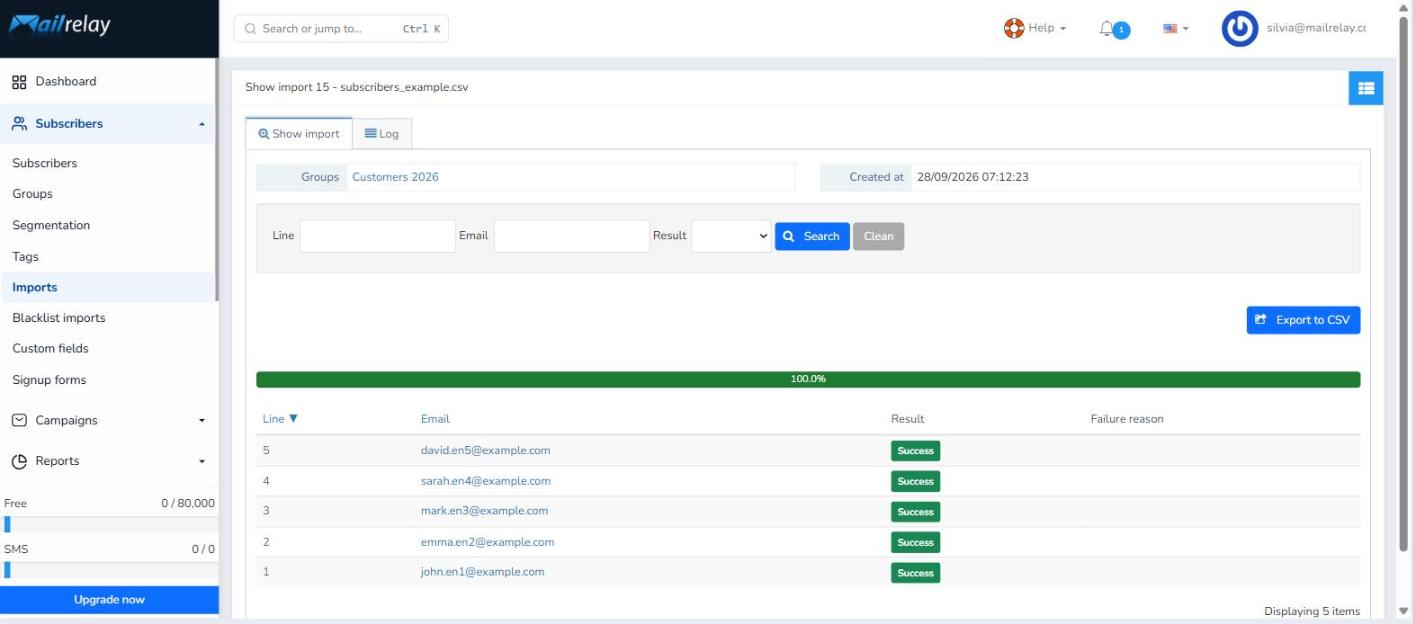
When it finishes, you will see the Show import screen with the file name, the target Groups, the Created at date and a progress bar. For each Line, the table shows the Email, the Result (for example, Success) and, if it failed, the Failure reason.
- Filter by Line, Email or Result to find specific contacts.
- Use Export to CSV to download the result.
- The Log tab contains the log of the process.
You can come back to this summary at any time from the imports list, using the magnifying-glass button.
3. Import from Mailchimp or HubSpot
If your contacts are in Mailchimp or HubSpot, choose Mailchimp Import or Hubspot Import in step 1 and follow the wizard to connect your account. We have written a detailed tutorial covering the two ways to import your Mailchimp contacts into Mailrelay.
4. How to view the subscribers in a group
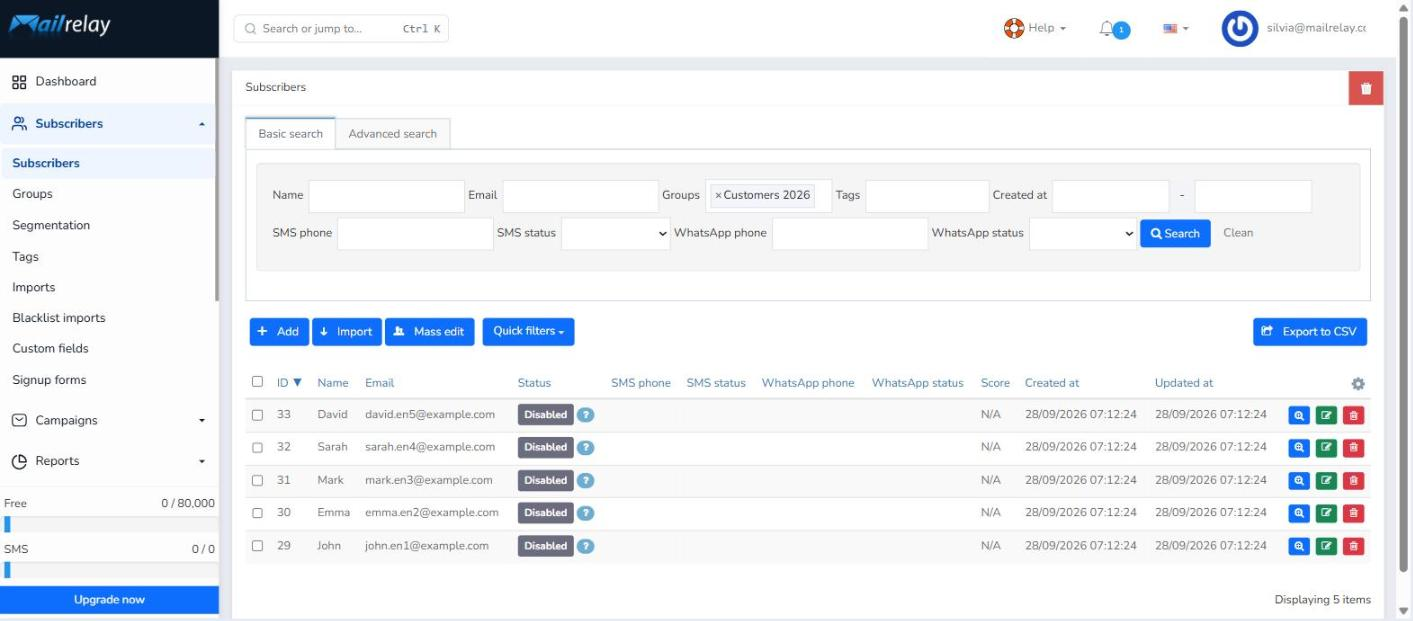
Go to Subscribers > Subscribers. In Basic search, click the Groups field to see all the groups in your account and select one (or several, if you want to see the subscribers of several groups at once).
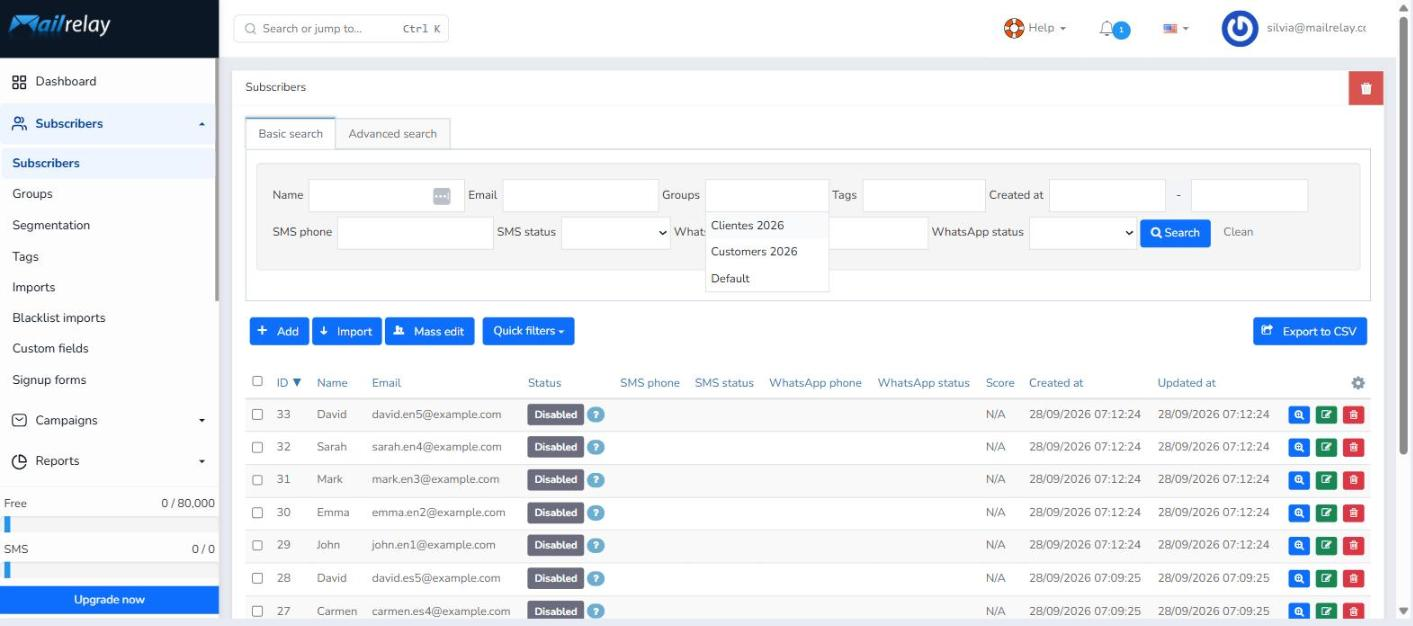
Click Search. The table will show only the contacts in the selected groups. To download them, use the Export to CSV button.
Was this article helpful?
That’s Great!
Thank you for your feedback
Sorry! We couldn't be helpful
Thank you for your feedback
Feedback sent
We appreciate your effort and will try to fix the article