If you are switching email marketing platforms, you can move your subscriber list from Mailchimp to Mailrelay in a few minutes and keep sending your newsletters without losing a single contact. Imports are available on all accounts, including the free account.
There are two ways to import your Mailchimp contacts into Mailrelay:
- Export your Mailchimp contacts to a CSV file and import it into Mailrelay. This also gives you a backup of your contacts that you can keep on your computer.
- Import them directly with the Mailchimp API. It is faster, but it does not create that backup.
Use whichever suits you best. In this article we explain both, step by step.
TABLE OF CONTENTS
- 1. Import your Mailchimp contacts with a CSV file
- 2. Import your contacts with the Mailchimp API
- Frequently asked questions
1. Import your Mailchimp contacts with a CSV file
The first thing you need to do is export your contacts. To do this, log in to your Mailchimp account, click Audience >> All contacts and then click the Export Audience button.
A new window will open telling you that you will receive an email to download your contact list.

Find and open the email, and click the Download List Data button. A .zip file will be downloaded, which you need to unzip to access your account's contacts.

The .zip file contains two .CSV files: one with a name similar to subscribed_members_export_xxxxxxx.csv, with your active contacts, and another with a name similar to unsubscribed_members_export_xxxxxxx.csv, with the contacts who have unsubscribed from your campaigns.
1.1 Import active contacts
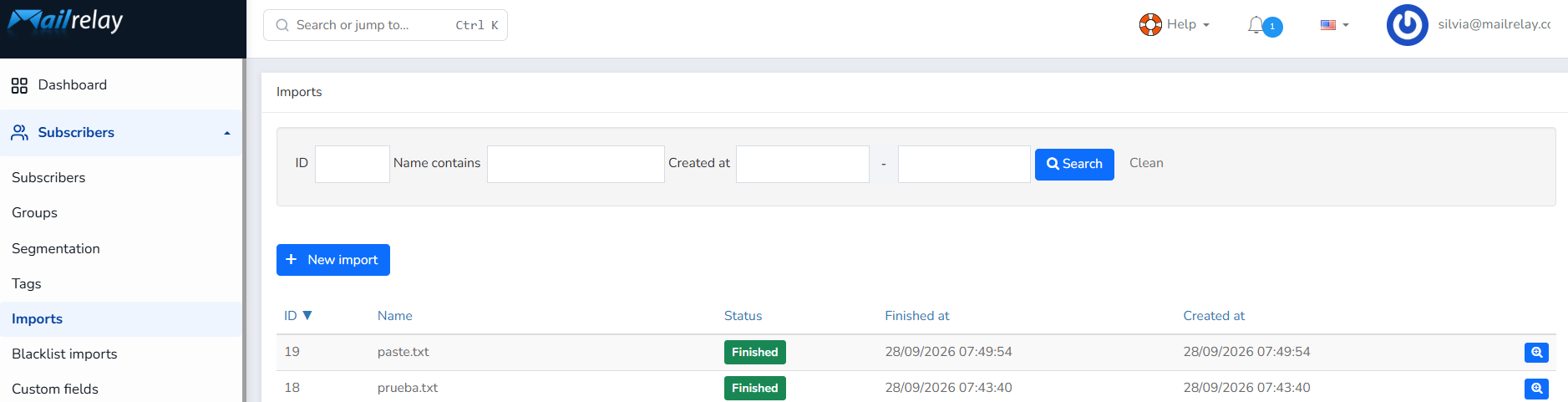
Now you just need to import the active contacts from the subscribed_members_export_xxxxxxx.csv file into Mailrelay. To do this, go to Subscribers > Imports and click the +New import button.
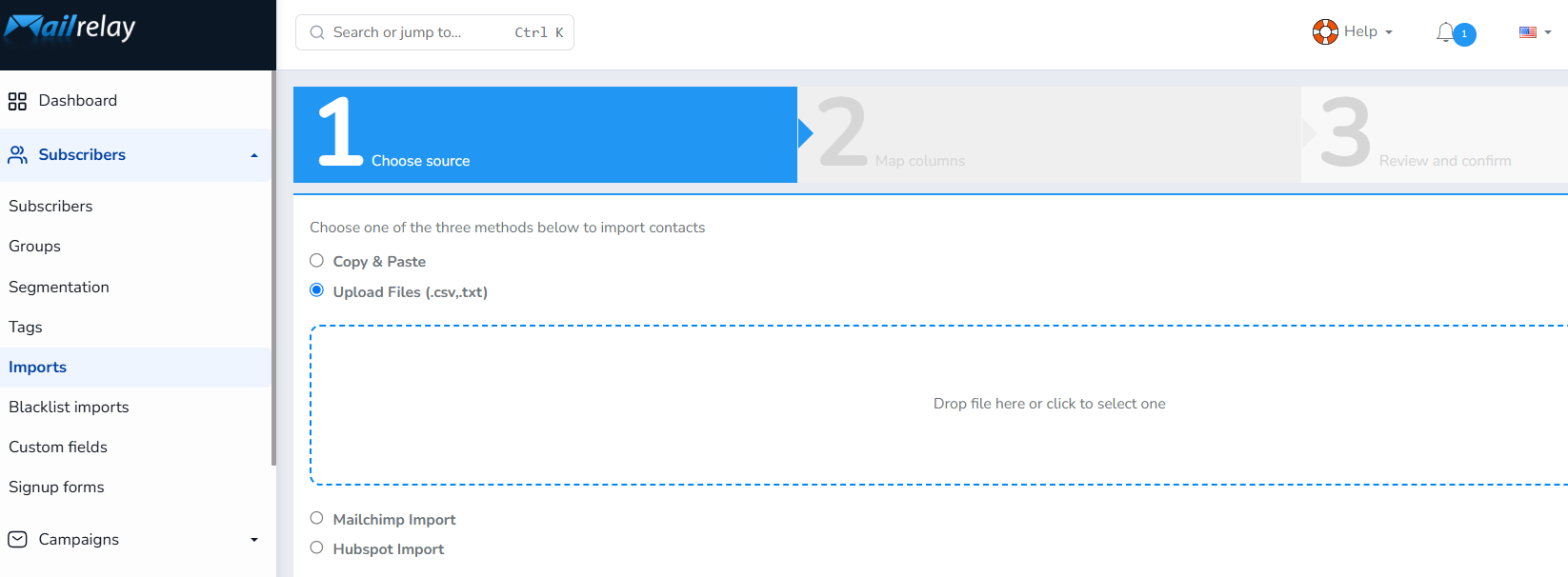
In the new window, select Upload Files (.csv, .txt) and drag the subscribed_members_export_xxxxxxx.csv file onto the Drop file here or click to select one area, or click it to browse for the file on your computer.
The system then analyzes the file, identifies the fields it contains and shows you a preview. If you want to change the field each column is matched to, change the value in the drop-downs in the Field column. If you need to store data that has no field in Mailrelay, you can create your custom fields first.
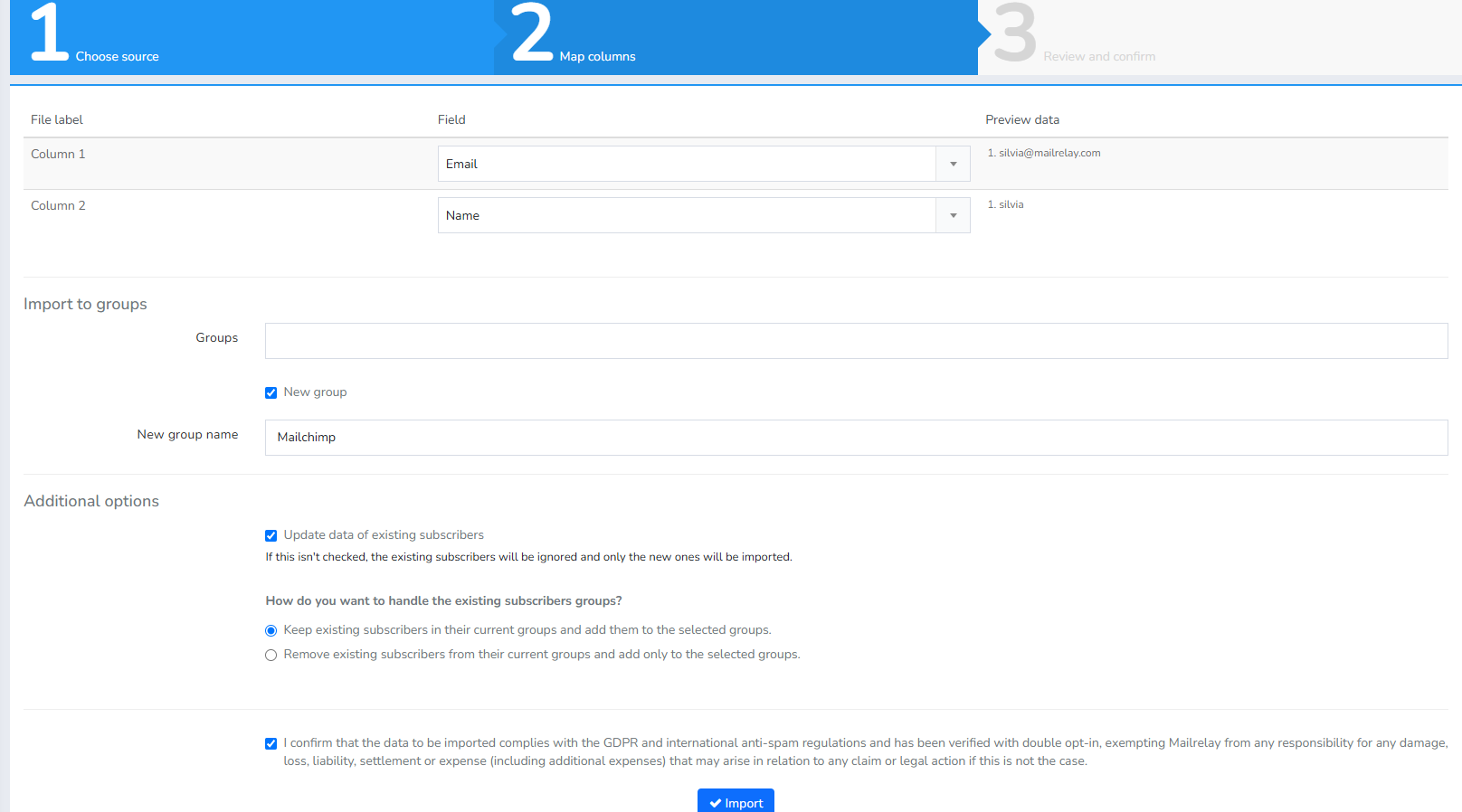
In the Import to groups area, choose the group you want to import the contacts into from the Groups drop-down. If you prefer to create a new group, tick New group and type its name.
Below, under Additional options, choose what to do with the contacts that already exist in your account:
- If you don't tick Update data of existing subscribers, existing subscribers will be ignored and only new ones will be imported.
- If you tick it, you can choose between two options:
- Keep existing subscribers in their current groups and add them to the selected groups: the contacts stay in the groups they were already in and are also added to the new one.
- Remove existing subscribers from their current groups and add only to the selected groups: the contacts are removed from the groups they were in and added only to the new ones.
Finally, tick the box declaring that the data you are importing complies with the GDPR (if applicable to your account) and international anti-spam regulations, and that it has been verified with double opt-in.
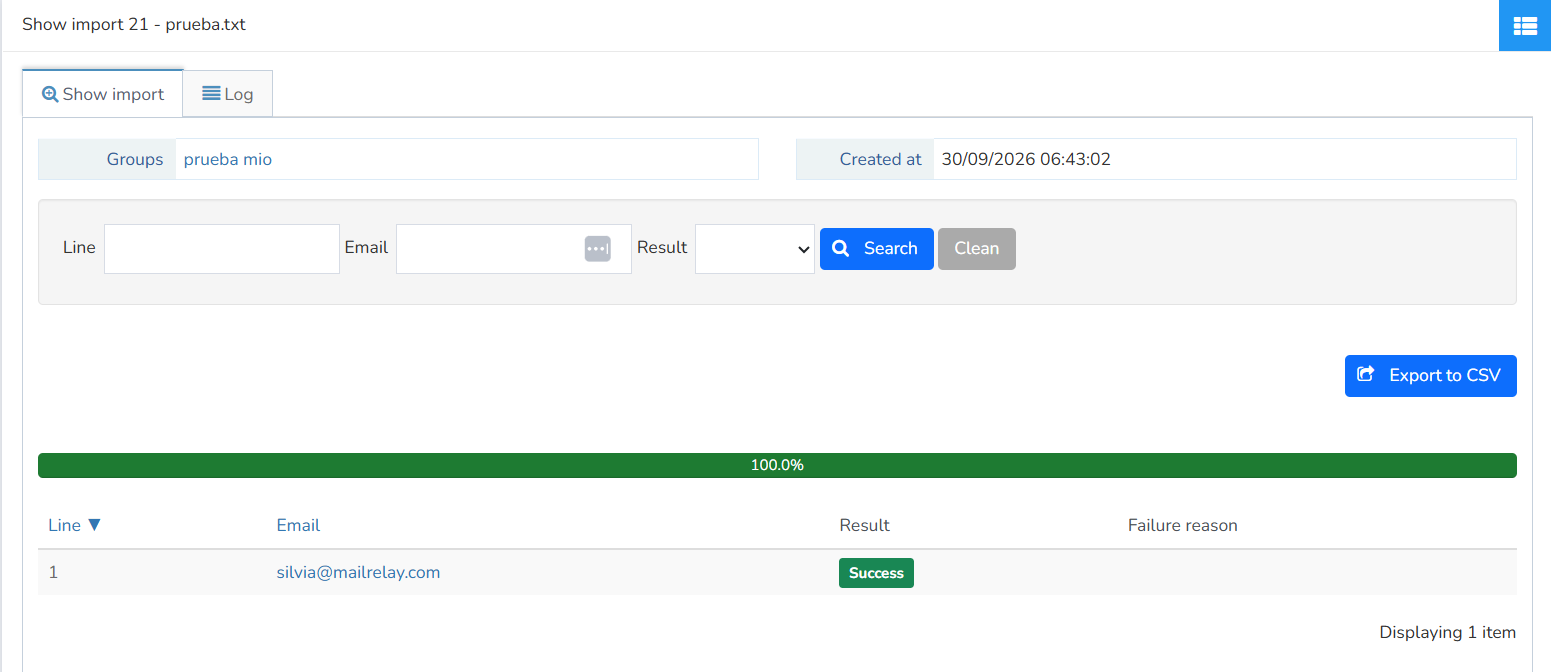
When everything is ready, click Import. When the import finishes, you will see a summary with the result for each contact, so you can check whether there were any errors.
You will find more details about each step in the article Imports.
1.2 Import contacts who unsubscribed in Mailchimp
Contacts who have unsubscribed have made it clear that they don't want to receive your emails anymore. That is why we recommend importing them into Mailrelay too, but into the blacklist, so you don't send them anything by mistake.
To do this, go to Subscribers > Blacklist imports and click the + New blacklist import button.

Upload the unsubscribed_members_export_xxxxxxx.csv file, tick the Create banned subscribers even if they don't exist option and click Import.

You can see how it works in detail in the article Blacklist imports.
1.3 Recover a blacklisted email
If you imported an email into the blacklist and the subscriber wants to receive your emails again, you can recover it and put it back in your list of active contacts. To do this, go to Subscribers > Subscribers, type the email in the Email field and click Search. In the results you will see the contact with the disabled status.
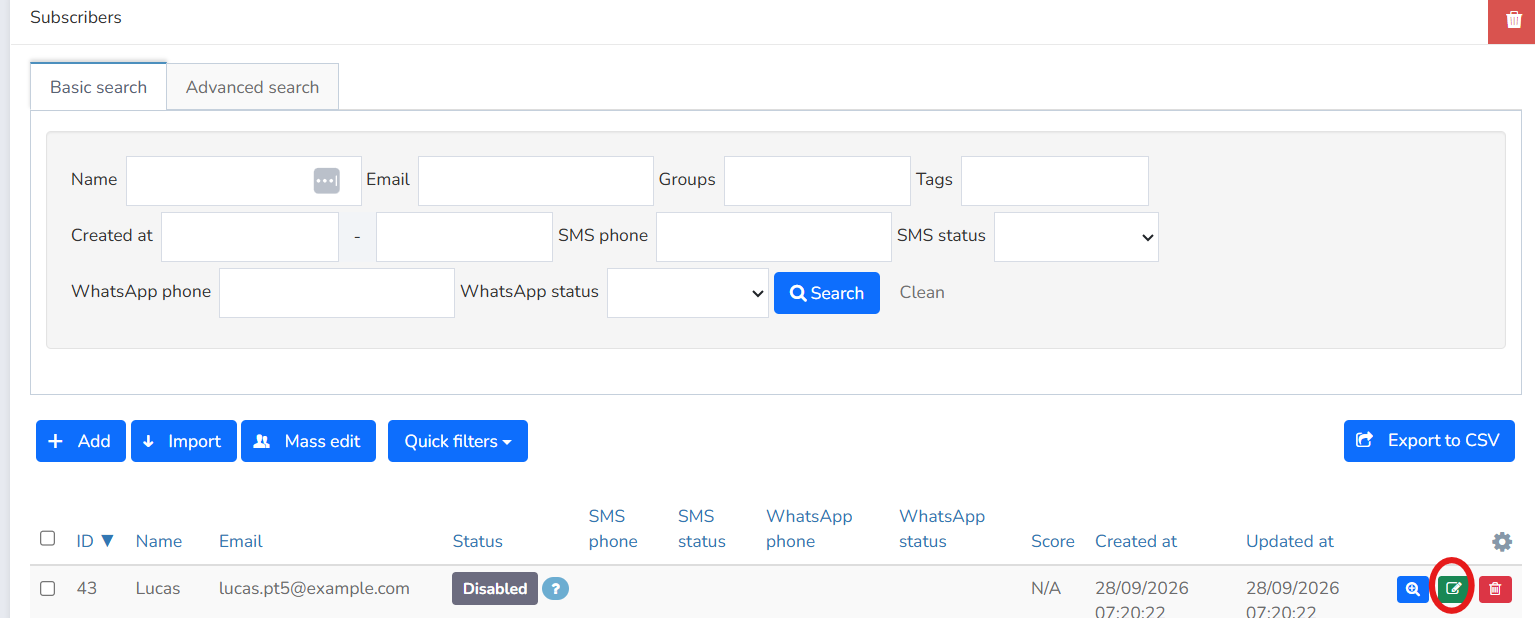
To change this status, click the green Edit button (pencil icon) to open the subscriber's details. Then open the Actions drop-down and select Unban.
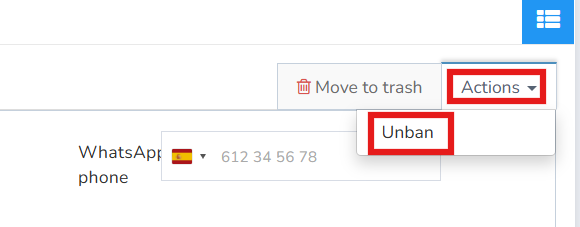
You will see a confirmation window. Click Yes and the subscriber will be removed from the blacklist.
Important: from the Actions menu you can only remove from the blacklist the emails that you added yourself. If an email is blocked on the blacklist because it appears on an advertising exclusion list, you can enable it again if the subscriber signs up through your account's signup form.
2. Import your contacts with the Mailchimp API
With this second option you connect your Mailchimp account to Mailrelay and import your contacts directly through the Mailchimp API, without downloading any file.
2.1 Get your Mailchimp API key
In your Mailchimp account, click your user icon (top right) and select Account & billing. Then click Extras >> API keys >> Create New Key.

Type a descriptive name for your key in API Key Name (for example, Contacts) and click the Generate Key button.

On the next screen you will see the API key you need to import your contacts. Copy it manually or with the Copy to Clipboard button. Once you have it, click Done.
2.2 Import your contacts with the API key
With the API key copied, go to Subscribers > Imports in Mailrelay and click +New import.
In the new window, select Mailchimp Import. Paste the API key into the Mailchimp API key field (it is a string of letters and numbers similar to e58e23743434b3349f2dae2747ech43434fc2-us3) and press Enter.
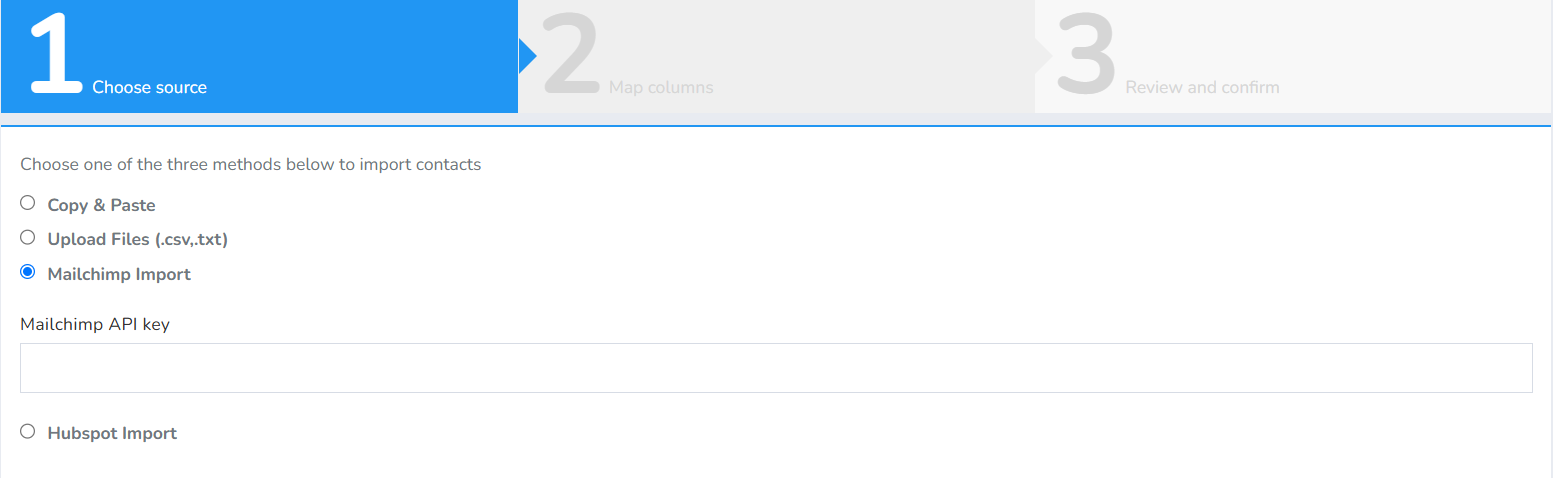
A drop-down with your Mailchimp lists will appear. Choose the contact list you want to import into Mailrelay and click the import button.
The system analyzes the contacts, identifies their fields and matches them with the fields that already exist in your account. If you want to change any of them, change the value in the drop-downs in the Field column.
From here on, the process is the same as in section 1.1: choose the group in Import to groups (or create a new one, for example Imported via MC API), choose under Additional options what to do with existing subscribers, tick the GDPR box and click Import.
When the import finishes, you will see a summary with the result for each contact, so you can check whether there were any errors.
Frequently asked questions
Can I move my Mailchimp contacts to the Mailrelay free account?
Yes. Imports, including Mailchimp imports, are available on the free account. On the free plan you can import up to 40,000 subscribers, twice the plan's subscriber limit.
Which option is better, the CSV file or the Mailchimp API?
Both import your contacts. With the CSV file you also get a backup on your computer and you can import the contacts who unsubscribed into the blacklist. With the API the process is faster, because you don't have to download or upload any file.
What should I do with the contacts who unsubscribed in Mailchimp?
Import them into the Mailrelay blacklist, as explained in section 1.2. This way you won't send them any email by mistake.
Why does an imported contact appear as disabled?
Click the ? icon next to the contact to see the reason. One of the most common is that the email is on the blacklist. If you added it yourself, you can remove it as explained in section 1.3. If it is on the blacklist because it appears on an advertising exclusion list, you can enable it again if the subscriber signs up through your account's signup form.
What happens if some contacts already exist in my Mailrelay account?
It depends on the Update data of existing subscribers box. If you don't tick it, those contacts are ignored and only new ones are imported. If you tick it, their data is updated and you can choose whether they stay in their current groups or move only to the new ones. You can manage them afterwards from Subscriber management.
Was this article helpful?
That’s Great!
Thank you for your feedback
Sorry! We couldn't be helpful
Thank you for your feedback
Feedback sent
We appreciate your effort and will try to fix the article