Emails in Processed status
Sometimes, when you send a newsletter, some of the emails to your subscribers may remain in Processed status for a while.
In this article, we explain the possible causes of emails in Processed status and when you need to contact our support team.
TABLE OF CONTENTS
- Emails in Processed status
What does it mean when messages or emails are in Processed status?
When a message we are sending remains in Processed status, it means that the message cannot be sent at that moment and must stay in the outbox until the problem is resolved.
There may be emails in Processed status that need to go out quickly to avoid disrupting our schedule, although sometimes the cause has nothing to do with the email marketing software you use.
Maximum time in the queue
5 days by default. If the email cannot be delivered within that time, it is discarded and marked as "Soft bounce".
Retry frequency
There is no fixed interval. Our server adjusts retries automatically based on the error returned by the provider. For example, if the provider indicates that the sender domain has exceeded its hourly message limit, there is no point retrying every minute, so the next attempt is made 1 hour later. On the other hand, if it is a connection or timeout error, the retry happens very quickly, within a few seconds. If it keeps failing, the time between retries increases.
Where can I see my emails in Processed status?
When you send an email, you can see which emails are in Processed status under Reports > Sent campaings> Show, (using the magnifying glass with a +), in the Sent emails section.
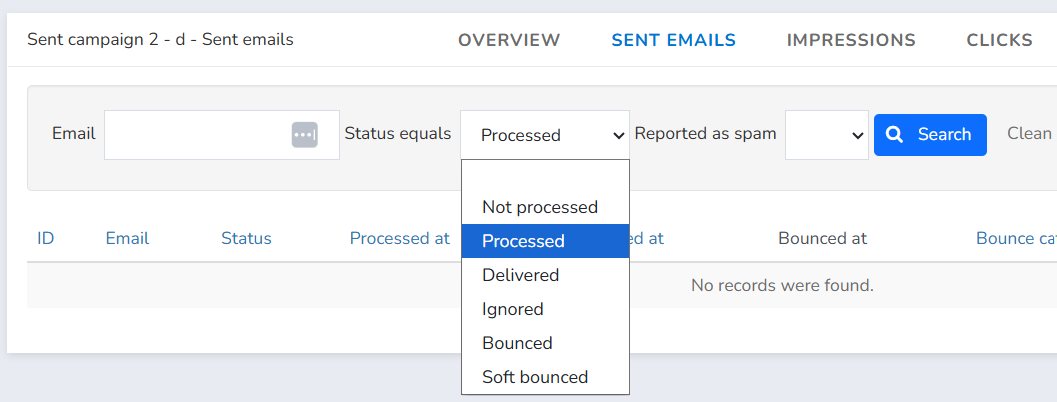
This means that some messages are waiting for a new delivery attempt, as requested by the destination server.
Why do some emails stay in Processed status?
Emails usually stay in Processed status for one of the following reasons:
Emails in Processed status at Gmail: rejections due to sending volume
This usually happens with large ISPs such as Gmail, Outlook.com or Yahoo!, since smaller ones normally lack the technical infrastructure to apply this kind of action. These rejections are usually not permanent; delivery simply becomes much slower and the messages remain in Processed status at Gmail.
SPAM-related rejections
When we send a newsletter, filters gradually analyze the content of the emails and how subscribers react to them. This slower delivery flow exists precisely so the sending can be examined closely.
If the filters detect that users are rejecting the content as unwanted or harmful, the messages will likely be considered spam and the emails still in Processed status may be blocked.
Emails are usually delivered in the end, unless one of the large ISPs blocks the sending IP, in which case delivery will stop.
This is uncommon, but it can happen.
Greylisting
Some servers deliberately reject the first delivery attempt from an unknown sender and only accept the email if it is retried after some time. It is an anti-spam technique, because legitimate servers retry and many spam senders do not. That is why we cannot retry immediately: we must wait for the minimum time required by the receiving server, which can range from a few minutes to several hours.
Problems with the receiving server
The server may be down, overloaded or experiencing temporary issues. We keep retrying until it works again or until the maximum time in the queue is reached.
Misconfigured destination domain
DNS problems, missing MX records, etc. If the problem is fixed within the time limit, the email is delivered.
Limits per sender domain
Gmail and other providers limit the number of emails per hour they accept from the same sender domain. In large campaigns with many recipients at the same provider, some emails wait their turn and are delivered as the provider accepts them.
- Temporary IP block at a specific provider
Emails to that provider wait until the IP is enabled again.
- Sending schedule configured in the campaign
If the campaign has time slots, emails remain in "Processed" status until the allowed time slot arrives.
How do I fix emails or messages in Processed status?
On the one hand, this is not common. On the other, we cannot prevent it 100%. But here are some options:
First, wait about four hours and then check the sending status:
- If there are fewer emails in Processed status, keep waiting, as delivery is in progress.
- If the number of emails in Processed status has not decreased, you can contact support.
How can we prevent this from happening with our newsletters?
- Keep in mind that Mailrelay IPs are shared (although you can purchase dedicated IPs); because they are shared, emails from your IP "neighbors" affect your own messages. However, if we all follow good email marketing practices, everyone benefits and we avoid the problem of processed emails.
- Sending newsletters within limits suited to our reputation and avoiding being marked as SPAM as much as possible will help not only us, but also our IP neighbors.
- Remember that your sending domain can be blocked. We should not use newly registered domains as senders, to avoid blocks.
In the end, it is all about following standard best practices.
So, as for why some emails end up in Processed status, it is mainly due to a sending volume that is too high for the reputation of the IP or domain, or because our messages have been marked as SPAM several times.
Check the status of the newsletter and, if it has not been delivered for a while, contact support.
CAN PROCESSED EMAILS BE DELETED? By default, it is not possible to delete processed emails and prevent them from being delivered later, when the destination server finally accepts the message. However, this is sometimes necessary, for example for a promotion with an expiry date or due to local regulations that prohibit sending emails after a certain period. If this is your case, contact us and we can enable a button in your dashboard to manually delete emails in Processed status. |
Was this article helpful?
That’s Great!
Thank you for your feedback
Sorry! We couldn't be helpful
Thank you for your feedback
Feedback sent
We appreciate your effort and will try to fix the article